After 12 years running precision jobs for clients across Germany, the UK and the US, I can say this with confidence:
The most expensive mistake you can make on a CNC project happens before the first chip is cut.
I've seen it a hundred times. An engineer picks 7075 for a simple bracket, or titanium for a part that never sees load. Then we spend the whole project fighting extra tool wear, longer cycle times,
and higher scrap. The part works, but it costs twice what it needed to.
Conversely, pick the wrong material for a high-stress application, and it fails in the field — and the machine shop gets blamed for something that was decided at the design table.
This guide breaks down the three most common CNC material families in plain shop-floor language. No textbook specs — just what actually matters when you're making parts.
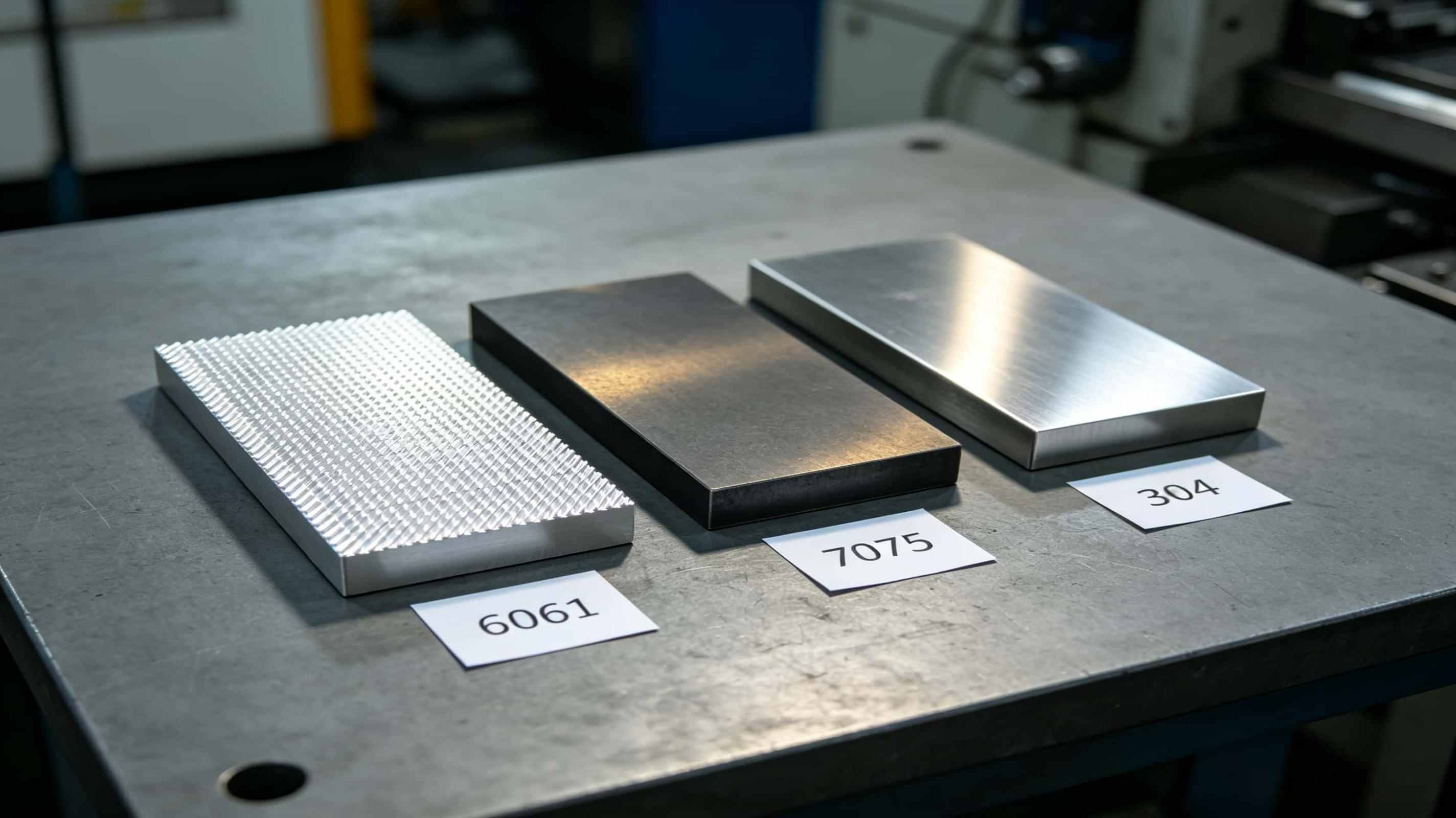
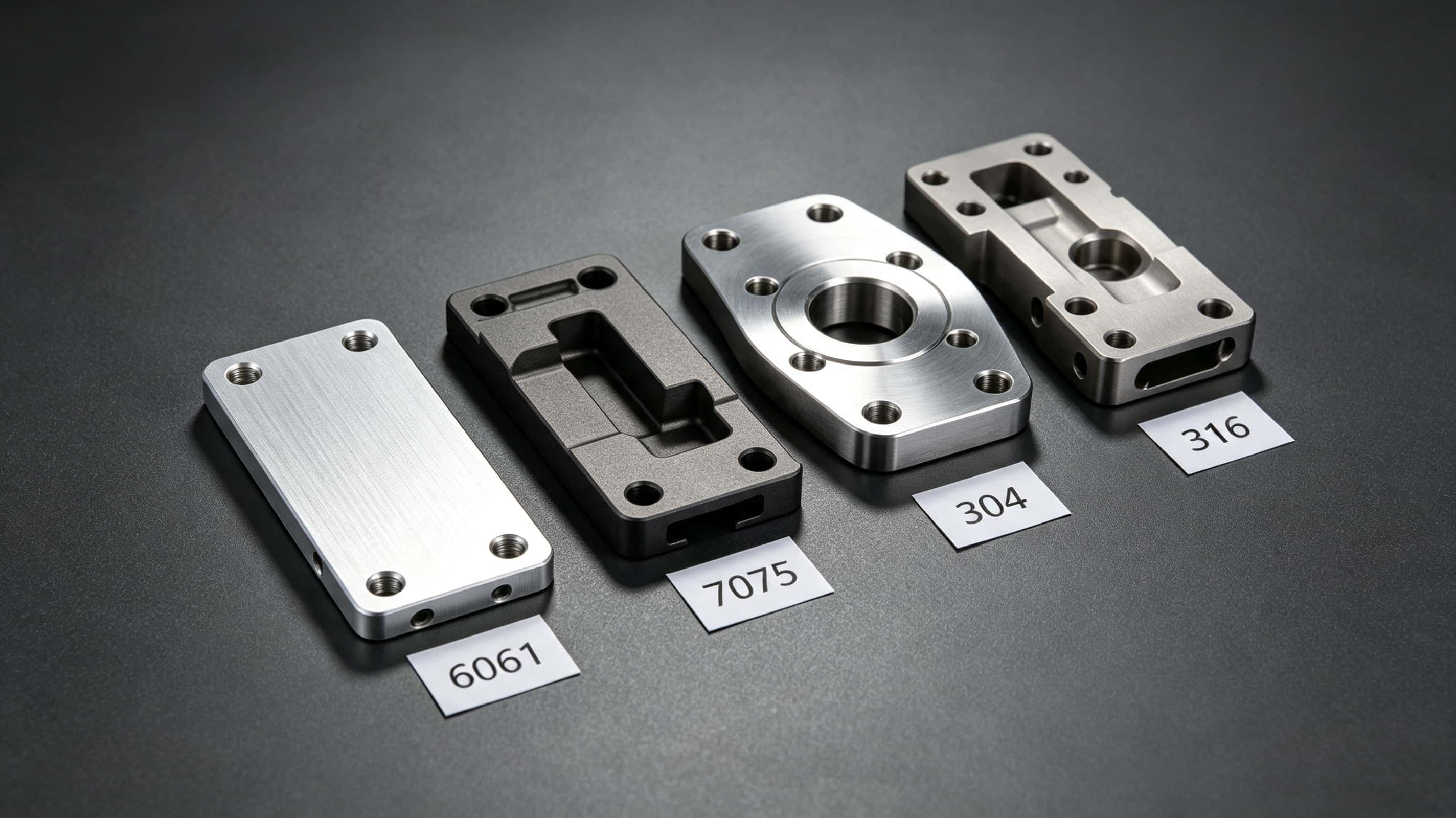
Aluminum makes up 60% of what we machine. It cuts fast, it's forgiving, and it's cheap relative to steel and titanium. But the gap between 6061 and 7075 is bigger than most buyers realize.
If there's no specific reason to pick something else, we recommend 6061. Always.
It machines beautifully. Carbide end mills last thousands of parts. Cycle times are fast. It anodizes evenly. It welds. For general brackets, housings, fixtures and prototypes, it's almost always the right call.
Real shop numbers: Tensile strength ~310 MPa. For a typical bracket, we run 8–12 minute cycle times. Tool life is long enough that we barely think about it.
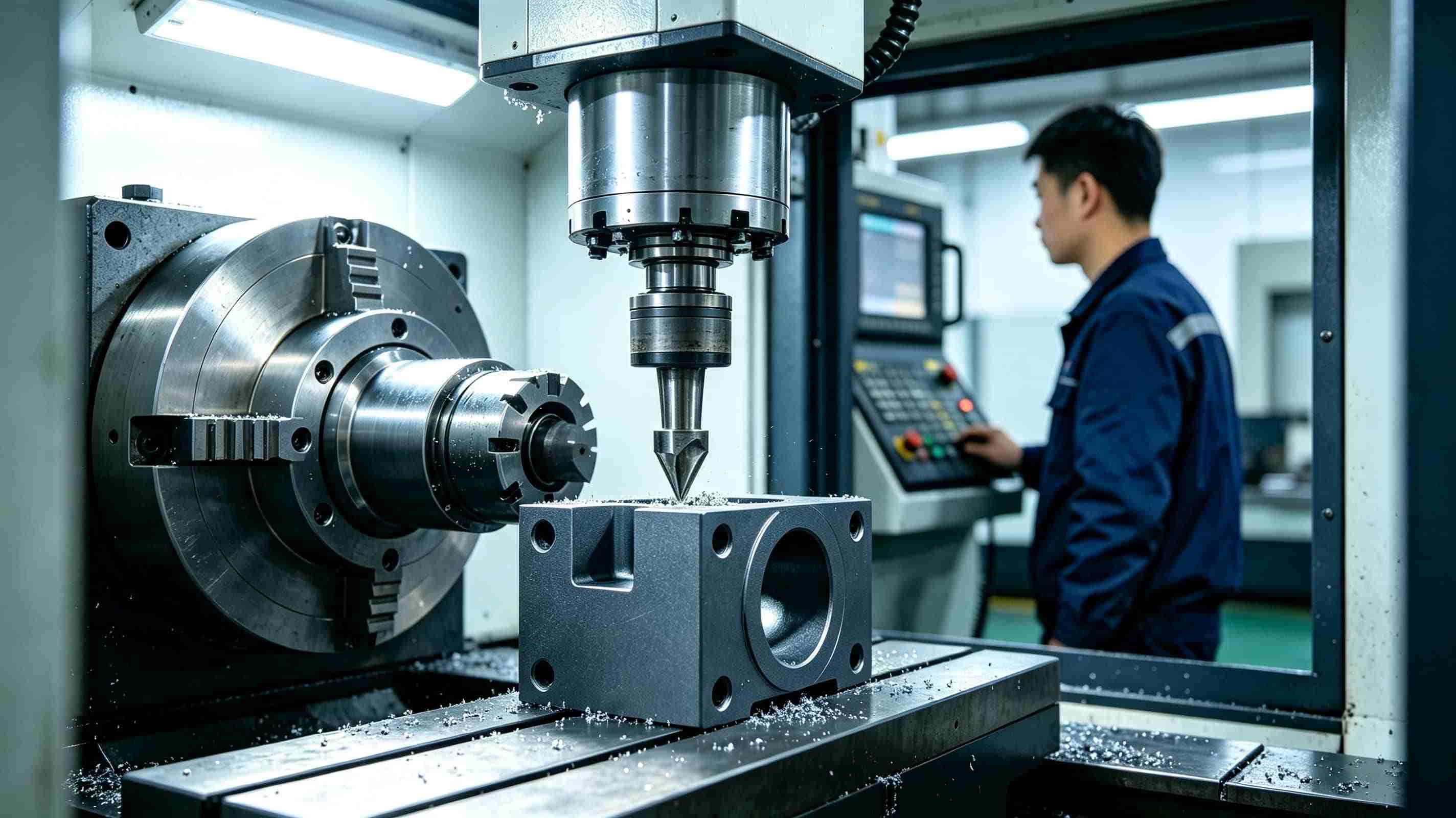
Best for: Fixtures, enclosures, general structural brackets, prototype work.
7075 has about 85% higher tensile strength than 6061 (572 MPa vs 310 MPa). It's the go-to for aerospace, defense and high-performance automotive.
But it is not just "stronger 6061." It machines completely differently.
It's harder on tools — expect 30–50% shorter tool life. Cycle times run 20–30% longer. Material cost is about double. And it anodizes poorly; the copper content causes streaking and uneven color.
When it's worth it: Aerospace structural brackets, drone frames, suspension components, high-load automotive parts.
When it's overkill: If the part just holds something in place, you're wasting money.
A real example: The thin-wall EV cooling plates we covered in our warping control article use 6061, not 7075. The critical requirement was flatness — not ultimate tensile strength.
Switching to 7075 would have added about 40% to the part cost with zero functional benefit.
Stainless is one of the most over-specified materials in CNC work. A lot of buyers pick it because "it won't rust" — even when the part lives inside a dry cabinet.
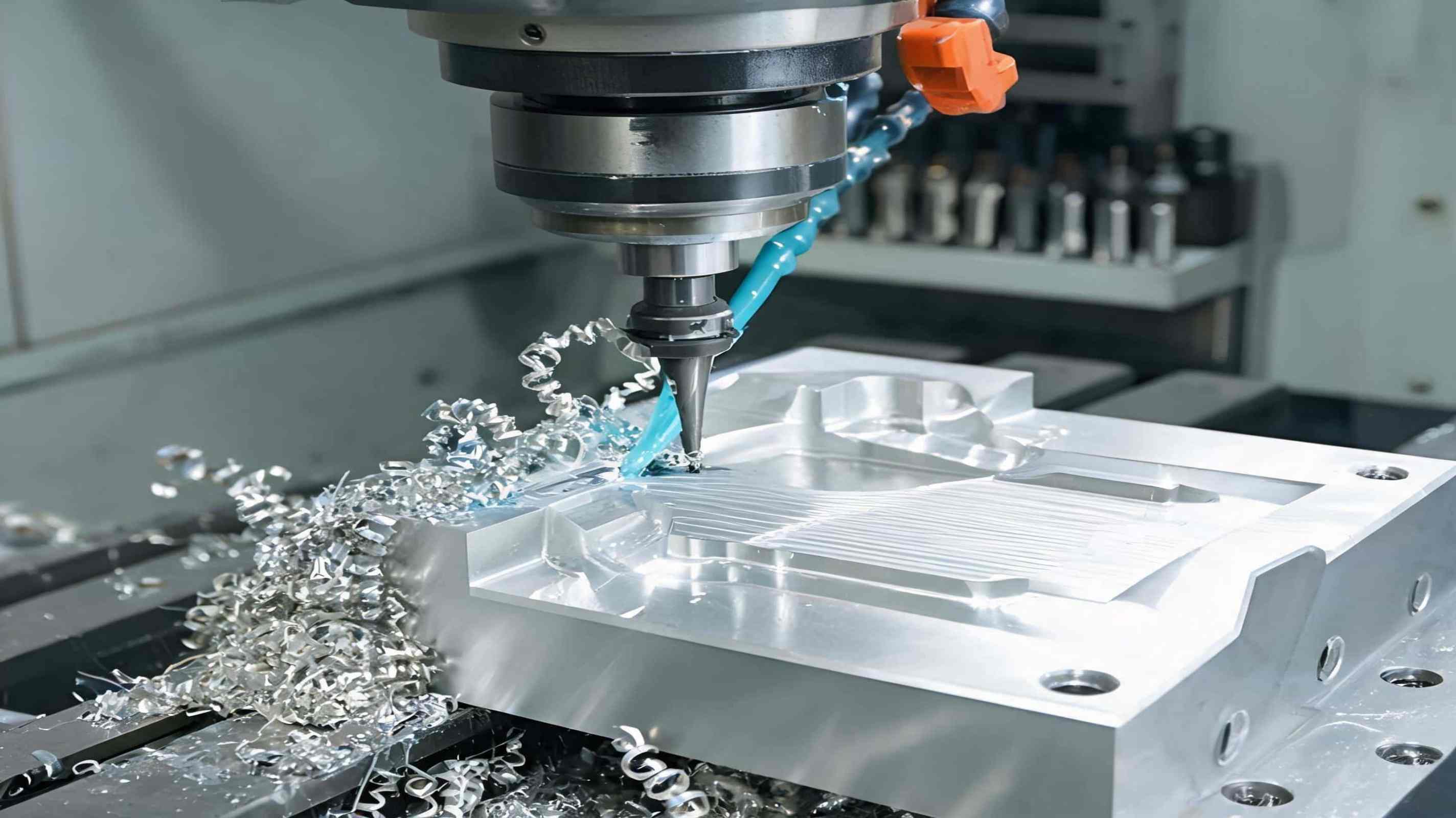
Stainless doesn't just cost more material. It machines 2–3× slower and eats tools. The total cost difference is way bigger than just the raw material price.
304 is the standard industrial stainless. It's corrosion-resistant, widely available, and food-safe. It also work-hardens like nothing else.
Here's what that means: if you take a light pass, or let the tool dwell, you harden the surface layer. The next pass has to cut through harder material. Tool wears faster. Dimensions drift.
How we handle it: Sharp positive-rake carbide, climb milling only, heavy consistent chip load, never dwell. If the tool stops moving while it's touching the part, you've already lost.
Best for: General corrosion resistance, food equipment, industrial enclosures.
316 adds molybdenum for much better chloride corrosion resistance. It's the standard for marine, pharmaceutical and surgical applications.
Machinability is nearly identical to 304 — which is to say, slow. Material cost is 20–30% higher.
The rule of thumb: If your part sees salt water, harsh chemicals or bodily fluids, use 316. If it just sees occasional moisture, 304 is fine. Don't spec 316 "just to be safe" — you're paying a premium for performance you'll never use.
One underrated point: Stainless holds tight tolerances better than aluminum. It's stiffer, deflects less, and thermal expansion is much lower. For very tight-tolerance parts in non-corrosive environments, steel is often a better choice than aluminum — even if it's heavier.
Titanium looks great on a spec sheet. High strength, low weight, excellent corrosion resistance, fully biocompatible. It's also a nightmare to machine, and extremely expensive.
The core machining challenge is heat. Titanium conducts heat very poorly. Almost all the cutting heat stays in the tool tip. That destroys tools fast. Cutting speeds have to be 50–80% lower than aluminum, and tool life is a fraction of what you get with steel.
When it's justified: Medical implants, aerospace parts where every gram matters, high-end racing components.
When it's a waste: Any application where 7075 or stainless would work. Titanium is 5–6× the material cost of aluminum and 3–5× the machine time.
All numbers below are relative to 6061 aluminum, based on our actual production data for equivalent part geometry.
|
Material |
Relative Machinability |
Relative Material Cost |
Cycle Time vs 6061 |
Best Real-World Use |
|
6061 Aluminum |
Excellent |
1.0× |
1.0× |
General fixtures, brackets, prototypes |
|
7075 Aluminum |
Good |
2.0× |
1.2–1.3× |
High-strength structural, aerospace |
|
304 Stainless |
Poor |
2.5× |
2.5–3.0× |
Industrial corrosion resistance |
|
316 Stainless |
Poor |
3.0× |
2.5–3.0× |
Marine, medical, chemical environments |
|
Ti6Al4V Titanium |
Very Poor |
5–6× |
4–5× |
Medical implants, aerospace weight-critical |
Run through these questions before you lock in a material:
1. Does the part carry significant load? If not, start with 6061.
2. Does it see moisture, chemicals or salt? No = aluminum. Yes = 304. Salt/medical = 316.
3. Do you need high strength AND low weight? Try 7075 first. Only jump to titanium if 7075 isn't enough.
4. Is this a high-volume production part? Machinability matters more than raw material cost. A material that cuts 3× faster saves more in machine time than it costs in material premium.
Conclusion
The cheapest material on the data sheet is almost never the cheapest finished part. And the strongest material is almost never the right choice for 80% of applications.
The best material choice meets your performance requirements — and no more. Over-specifying adds cost, extends lead time, and creates unnecessary machining risk.
Tel : 0755-23596843
WhatsApp : +86-13267211181
Email : sales02@gt-proto.com
No.18, Shaqi Community Center Road, Xinqiao Street, Baoan District, Shenzhen, Guangdong Province, China 518104