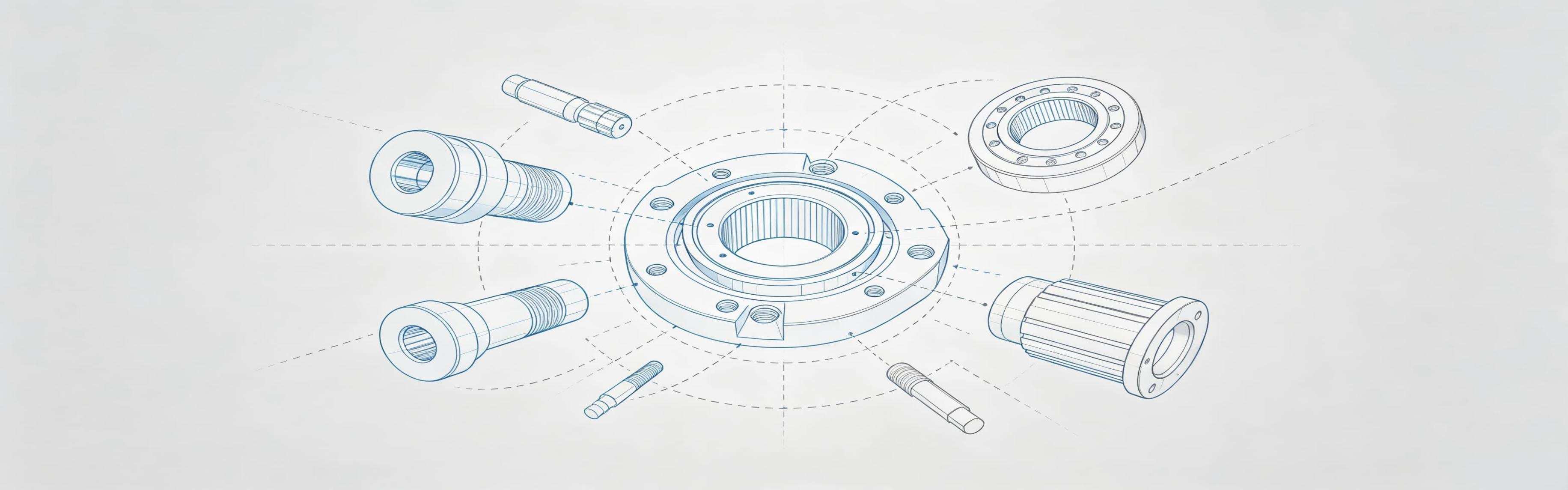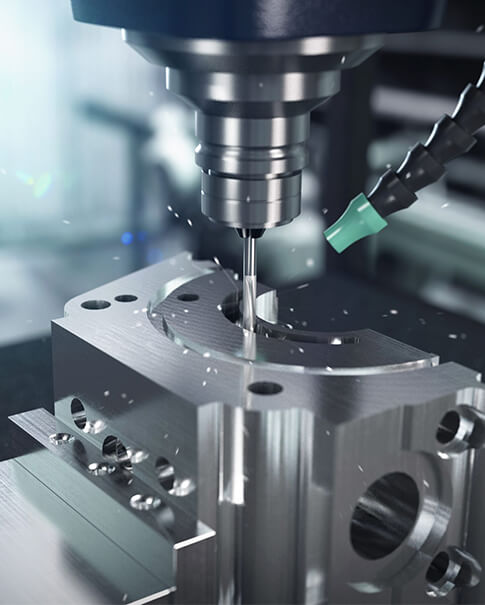
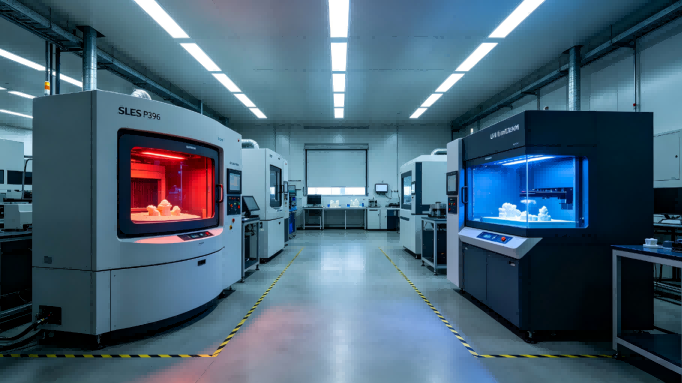
CNC machining is subtractive. You start with a block of material and remove everything that is not part. For many parts, that is the most efficient approach. But for parts with complex internal features, deep undercuts, or organic geometry, CNC machining becomes expensive — or impossible.
3D printing is additive. You build the part layer by layer, adding material only where it is needed. Complexity is almost free. A part with a complex internal lattice structure takes the same time and cost as a simple block.
For low volumes — 1 to 100 pieces — 3D printing is often faster and cheaper than CNC machining. For high volumes, injection molding or CNC machining usually wins. But the crossover point is moving higher every year as 3D printing technology improves.
We do not believe there is a single "best" 3D printing technology. The right technology depends on your part geometry, material requirements, surface finish needs, and budget.
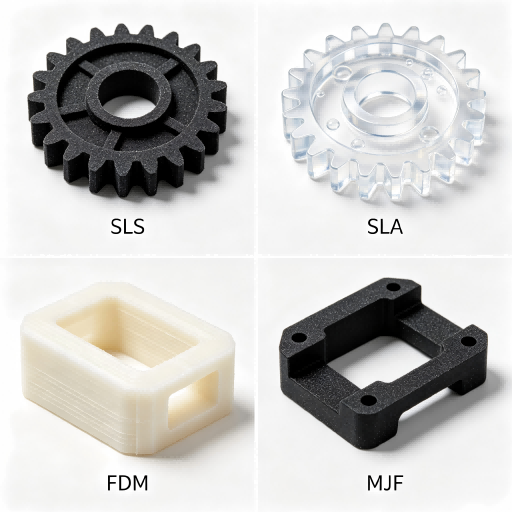
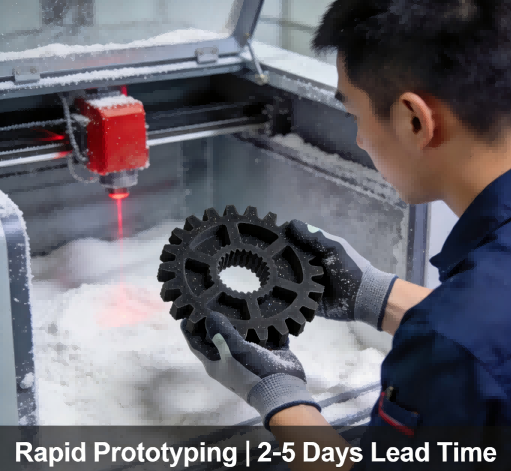
SLS (Selective Laser Sintering) uses a laser to fuse nylon powder into solid parts. No supports are needed because the unsintered powder supports the part during printing. SLS produces strong, durable parts with good temperature resistance (up to 185°C). Surface finish is slightly rough and porous — not suitable for cosmetic applications without post-processing, but excellent for functional prototypes and end-use parts.
SLA (Stereolithography) uses a laser to cure liquid resin into solid parts. Supports are required for overhangs. SLA produces parts with the smoothest surface finish of any 3D printing technology. Layer lines are nearly invisible. SLA is ideal for visual prototypes, medical models, and parts that will be painted or plated. The material selection is broad — standard, tough, flexible, transparent, high-temperature (up to 289°C), and castable resins.
FDM (Fused Deposition Modeling) extrudes molten plastic filament through a nozzle, building parts layer by layer. FDM has the largest build volume of any 3D printing technology — up to 900 x 600 x 900mm. It also supports engineering-grade materials like ABS, PC (polycarbonate), Nylon, PEEK, and Ultem. Surface finish is the roughest of the four technologies, with visible layer lines. But for large parts and high-temperature applications, FDM is often the only practical option.
MJF (Multi Jet Fusion) is HP's technology. It uses inkjet arrays to deposit fusing and detailing agents on nylon powder, then a heating lamp fuses the treated areas. MJF produces parts with properties similar to SLS but with slightly better surface finish and faster build times. For batches of 50-500 identical parts, MJF is often the most cost-effective option.
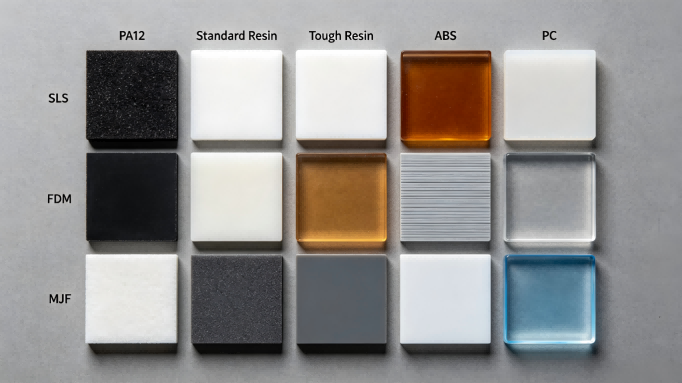
SLS Nylon PA12 is our most popular 3D printing material. Tensile strength of 48 MPa, elongation at break of 20%, heat deflection temperature of 185°C. It is tough, durable, and resistant to fatigue. Perfect for hinges, clips, housings, and functional prototypes.
SLA Standard Resin offers 45 MPa tensile strength but only 6% elongation — stiff and brittle. Best for visual models where strength is not critical. SLA Tough Resin offers 50 MPa tensile strength and 15% elongation — much more impact-resistant. SLA High-Temp Resin withstands 289°C, suitable for heat-resistant applications like soldering fixtures.
FDM ABS is the workhorse of FDM. 35 MPa tensile strength, 5% elongation, heat deflection of 98°C. It is strong enough for most functional applications. FDM PC (polycarbonate) offers 68 MPa tensile strength and heat deflection of 138°C. FDM PEEK offers 100 MPa tensile strength and 160°C heat deflection — suitable for aerospace and medical applications where high performance is required.
MJF PA12 is similar to SLS PA12 but with slightly better surface finish and isotropy. Production users often prefer MJF for batches of 100+ parts because the per-part cost is lower and the quality is more consistent.
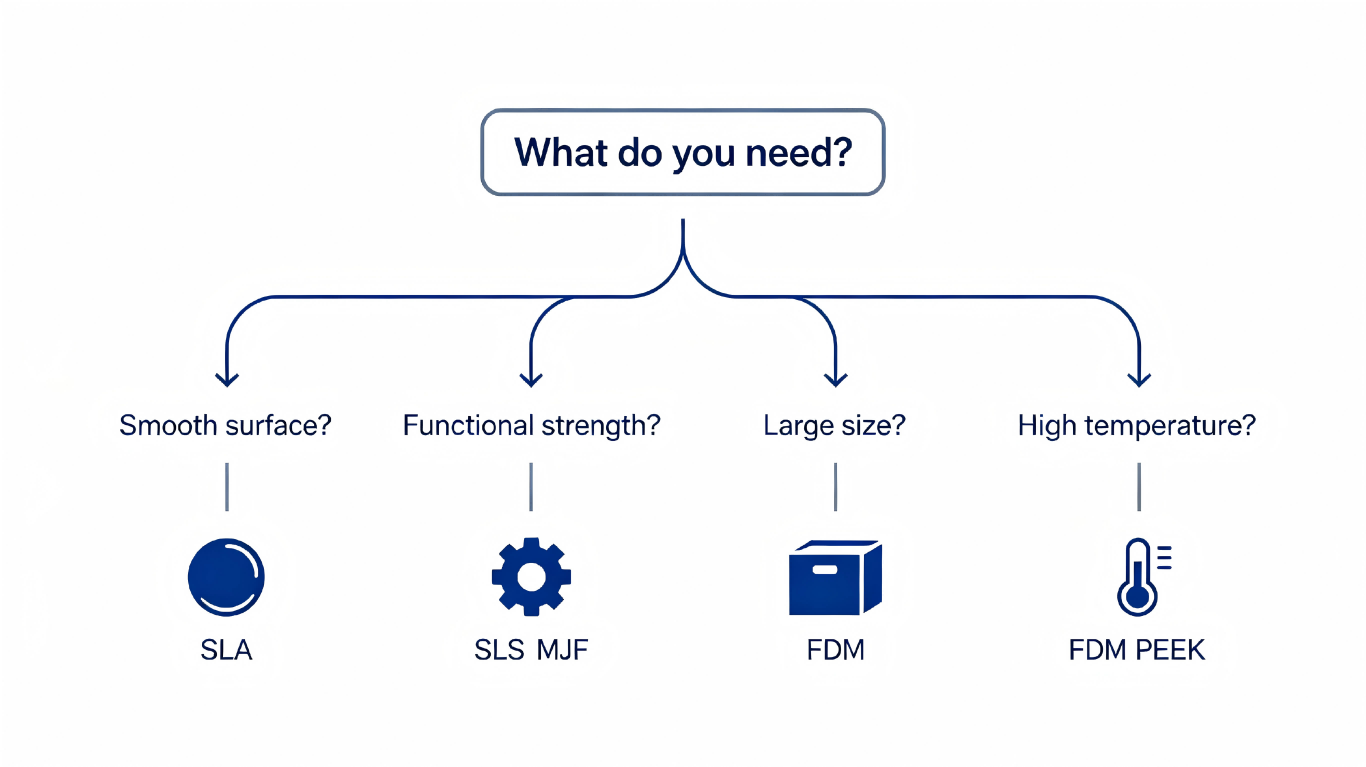
If you need a smooth, paintable surface for a visual prototype, choose SLA. If you need a durable, functional part that will be handled, assembled, and tested, choose SLS or MJF. If you need a very large part (over 400mm in any dimension), choose FDM. If you need high-temperature resistance (over 150°C), choose FDM with PEEK or Ultem. If you need transparent or optical parts, choose SLA with clear resin.
If you are still not sure, send us your file. We have run thousands of parts across all four technologies and can recommend the best fit based on your specific requirements.
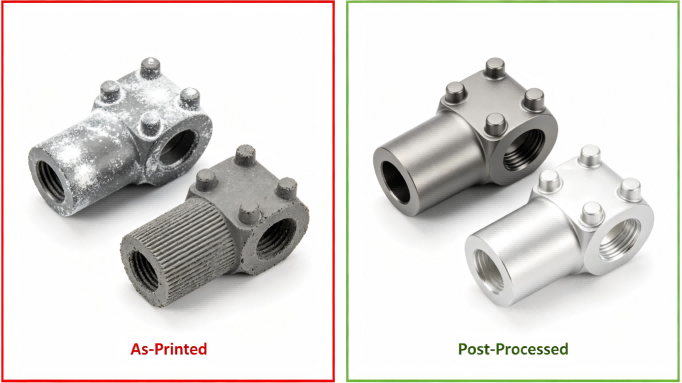
As-printed parts are not always ready to use. SLS and MJF parts come out of the printer covered in loose powder. We bead blast them to remove the powder, leaving a smooth, matte finish. For cosmetic applications, we can also tumble polish SLS parts to a semi-gloss finish.
SLA parts require support removal, which can leave small marks. We sand these marks smooth. For transparent SLA parts, we can apply a clear coat that restores optical clarity.
FDM parts have visible layer lines. For functional applications, we typically leave them as-printed. For cosmetic applications, we can sand and fill the layer lines, then paint the part.
If you have specific surface finish requirements, tell us when you request a quote. We will recommend the right post-processing steps.
For most 3D printing orders, we ship within 2-5 days. SLS and SLA are typically faster (2-3 days) because the machines run continuously. FDM can be slower (3-5 days) for large parts because each layer takes time.
Pricing varies widely based on part size, geometry, and material. A small SLS part (50 x 50 x 50mm) might cost $30-50. A large FDM part (300 x 200 x 100mm in PEEK) might cost $300-500.
We provide instant quotes for 3D printing. Upload your STL file and we will return pricing within 4 hours.
We offer both CNC machining and 3D printing. We do not push one over the other. Our job is to recommend the process that best fits your part, quantity, timeline, and budget.
That said, here is a rule of thumb we use: if the part has complex internal features or organic geometry, start with 3D printing. If the part requires tight tolerances or specific material properties (like anodized aluminum or stainless steel), CNC machining is usually the answer.
And sometimes the answer is both. We frequently machine 3D printed patterns for vacuum casting, or use 3D printed fixtures to hold parts during CNC machining.
CTA: Upload your STL or STEP file for an instant quote. We reply within 4 hours.
Tel : 0755-23596843
WhatsApp : +86-13267211181
Email : sales02@gt-proto.com
No.18, Shaqi Community Center Road, Xinqiao Street, Baoan District, Shenzhen, Guangdong Province, China 518104